There is one simple business lesson every entrepreneur must learn. It's not enough to win a customer. You have to give them reasons to stay. As a sales and business coach, one of the most important lessons I share with business owners, sales professionals, and entrepreneurs is this:
Don't spend all of your time chasing the next new client or customer while ignoring the ones you already have. The people who have already trusted you with their business are invaluable to the success of your business.
Winning a new customer is exciting. But keeping an existing customer happy, engaged, and coming back can be one of the most profitable investments a business makes. Many times, businesses go above and beyond to win someone's business, only to become complacent once the sale is complete. The follow-up disappears. The personal attention fades. The thank-you becomes an automated receipt. And the customer who once felt important starts feeling like just another transaction.
That's a costly mistake.
Customer appreciation isn't just about being nice. It's a business strategy that can strengthen relationships, encourage repeat purchases, generate referrals, and increase Customer Lifetime Value (CLV). Of course, CLV refers to the net profit a customer brings to a business throughout their relationship with that business.
Let's talk about CLV and why it matters.
Here are 3 main reasons why your business should focus on CLV.
-
It can be far more expensive to acquire new customers than to retain existing ones. Harvard Business Review, in its October 2014 article,
The Value of Keeping the Right Customers, reported that acquiring a new customer can cost anywhere from five to 25 times more than retaining an existing customer, depending on the industry and which study is used.
-
Losing customers has a negative impact on the business beyond a lost sale. Constantly replacing customers can become a very expensive way to operate a business. In his Harvard Business Review article,
Learning from Customer Defections, Frederick Reichheld explained that customers who leave create a financial burden because businesses must continually spend resources replacing lost revenue.
-
Making minor improvements to customer retention can improve profitability. Loyal customers who spend repeatedly with a business are much more likely to refer other people to that business. Thusly, creating perks for loyal customers to influence customer retention is a smart business practice. According to the
Harvard Business Review, research by Frederick Reichheld of Bain & Company found that increasing customer retention rates by 5% can boost profits by 25% to 95%. A 2020 study on small service-based businesses (Hawkins & Hoon) similarly found that a 1% retention increase can yield up to a 5% positive shift in financial standing, with roughly 80% of future profits coming from 20% of existing customers.
For the above reasons and many others, it's vitally important for successful businesses to make it a priority to focus on customer lifetime value and retain as many customers as they can.
CLV is the number every business owner should pay attention to, and here's why:
To reiterate, Customer Lifetime Value (CLV) represents the total value of the business you can expect from a customer over the entire relationship with your company.
Here's an example:
- A customer spends $2,500 annually with your company and remains a customer for five years. That amount equals $12,500 in revenue over the entire five-year relationship.
- Now imagine that, through better customer appreciation, communication, service, and relationship management, that same customer stays for eight years instead of five. That's $20,000 in revenue.
- Now rather than $12,500 in revenue, you made $20,000 which represents an increase of $7500 from one customer.
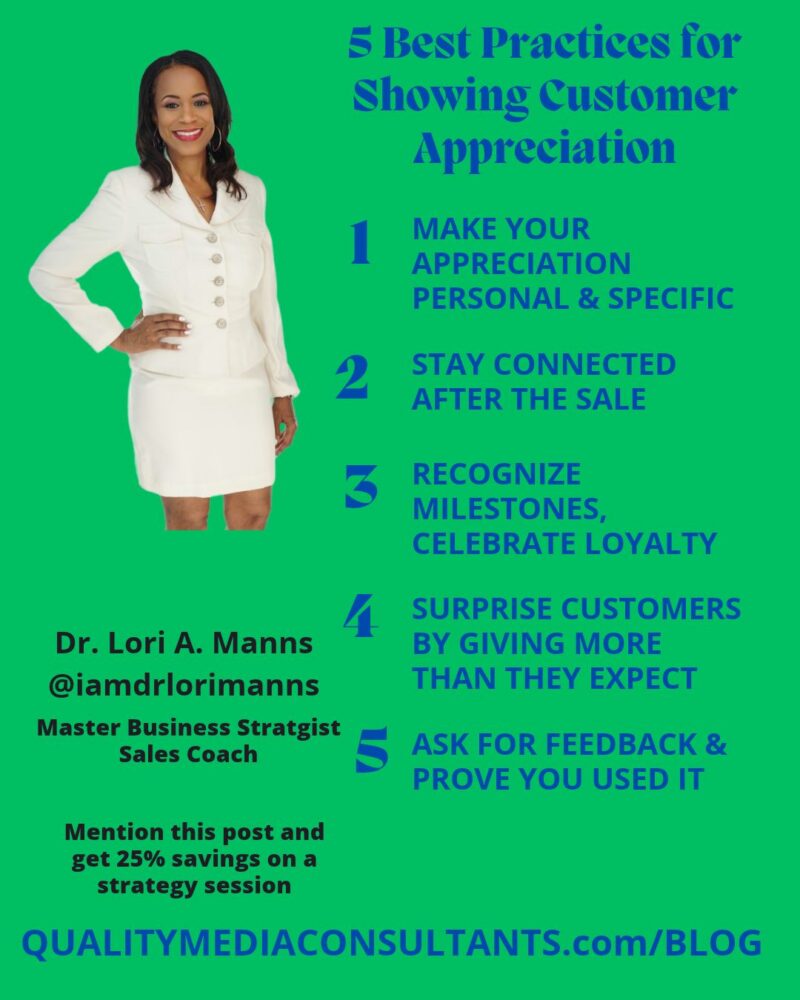
5 Best Practices for Showing Customer Appreciation
1. Make Your Appreciation Personal, Specific, and Genuine
Everyone appreciates being thanked. But there's a big difference between receiving a generic automated message and hearing a sincere, personalized thank-you.
Customers want to know that you recognize them as people, not just account numbers or revenue opportunities.
What does making your gratitude and appreciation look like in practice?
-
Sending personalized thank you notes or cards
-
Remember customer birthdays and holidays with a greeting card
-
Acknowledge how much their business is valued with random appreciate emails or letters
2. Stay Connected After the Sale — Don't Just Disappear
One of the biggest mistakes businesses make is investing heavily in the sales process and very little in the relationship afterward. Don't forget the follow up. There is fortune in the follow up. The sale is not the end of the customer relationship. It's the beginning of the next opportunity.
Following up demonstrates that you care about the customer's experience, even when there isn't an immediate opportunity to generate additional revenue.
What does staying connected after the sale look like in practice?
-
Call your customers one to two weeks after their purchase to see how things are going.
-
Check in after delivering a service or completing a project to get feedback.
-
Share helpful resources that could benefit your customer's business.
3. Recognize Milestones, Celebrate Loyalty, and Reward Continued Business
People appreciate being remembered. Recognizing customer milestones is a powerful way to demonstrate that you value the relationship beyond the revenue it provides for your business. If a customer has been loyal for 10 years, acknowledge loyalty in a special way.
Think about it: Businesses celebrate new customers all the time. Why not celebrate the customers who have stayed with them for years? Never take for granted that a customer will come back, rather give them reasons to come back year after year.
What does it look like to recognize and celebrate loyalty in practice?
- Celebrate a customer's one-year, five-year, or ten-year anniversary.
- Send a handwritten card on a business anniversary.
- Offer a special loyalty benefit or exclusive service.
4. Surprise and Delight Customers by Giving More Than They Expect
One of the best ways to differentiate your business is to deliver value beyond what the customer originally expected. This is a simple practice I call, overdelivering.
This doesn't necessarily mean giving away products or services for free. It means looking for opportunities to enhance the customer's experience or make it better than they anticipated. When customers feel that a business genuinely wants them to succeed, they have another reason to continue the relationship.
The 5 best practices above shouldn't be isolated gestures that happen when someone remembers to send a thank-you note. They should become part of your company's culture and everyday sales process.
What does it look like to surprise and delight your customers in action?
-
Offer an unexpected upgrade when appropriate.
-
Introduce customers to valuable professional contacts.
-
Provide early access to new products, services, or opportunities.
5. Ask for Feedback, Listen, and Prove That You Use It
One of the greatest forms of appreciation is showing customers that their opinions matter. You cannot build lasting relationships if you aren't willing to listen.
Customers want to feel heard and seen. They want to know their concerns are taken seriously and that their feedback can make a difference. But here's the part that matters: Asking for feedback is only the beginning. Acting on it is what builds credibility.
What does it look like to ask for feedback and prove that you use it in action?
- Conduct periodic customer satisfaction surveys.
- Ask customers what you're doing well and where you could improve.
- Personally contact customers who express dissatisfaction.
Don't Let Your Customers Forget Why They Chose You
Here's something I want every business owner, sales professional, and entrepreneur to remember:
Your customers have choices. The fact that they choose to do business with you is something you should never take for granted.
Don't wait until a customer is considering a competitor to remind them how much you appreciate their business. Don't wait until a contract is about to expire to reconnect. And don't assume that because a customer has been with you for years, they automatically know how much you value them. They don't…not necessarily.
Show them.
Tell them.
Demonstrate it consistently.
It will pay off in the long run.
Now it's your turn. Think about it.
What are some ways you will implement today to show appreciation to improve customer loyalty in your business? Don't just think about it. Make it a business practice and strategy that you implement on a daily basis.
##########
This article was written by Dr. Lori A. Manns, President of Quality Media Consultant Group LLC.
Want to use this article in your blog on on your website? Here's the author box you must include.
Dr. Lori A. Manns, CEO of Quality Media Consultant Group, a business consultancy firm specializing in advertising, media and sales solutions for your optimal success. Dr. Lori is the founder of Trailblazer Business Academy; ™ where purpose-driven entrepreneurs go to learn next level strategies to grow their businesses as well as, the Sponsorship Sales Secrets System; ™ that shows you how to get more sponsors and sales for your business, guaranteed. To book consultancy services on marketing, advertising/media, or sales and learn how to increase your revenue and grow your business; please visit www.qualitymediaconsultants.com
Join our newsletter list, and be amount thousands of business owners to get free tips, tools and resources to grow your business. Plus just for joining our newsletter, you get a gift, to help you learn the critical mistakes you could be making in the sales process. www.qualitymediaconsultants.com

Leave A Comment